FlowInquiry v1.2.2: Laying a Strong Foundation for What’s Next
We’re excited to announce FlowInquiry v1.2.2, a focused update that lays the groundwork for major features to come. As our customer base steadily grows and more teams integrate FlowInquiry into their daily workflows, we’re working hard to expand functionality and respond to user needs—even though FlowInquiry is still a young project. In this post, we’ll walk through what changed and why these improvements matter for future releases.
Database & Schema Refactor
What Changed
- Reorganized tables: Simplified relationships between tickets, teams, and users.
- Renamed columns & removed obsolete fields: Streamlined the schema so new tables (e.g., projects or reports) can be added more easily.
Why It Matters
- Fewer bugs: A cleaner data model reduces confusion when adding new modules.
- Faster development: Clearer table structures help developers understand data storage quickly, lowering the risk of mistakes.
Documentation Refresh
What Changed
- New tutorials & guides: Step-by-step instructions for extending and customizing FlowInquiry to fit your workflows.
- Writing integration tests without extra setup.
- Deploying FlowInquiry with Docker or our Helm chart.
- Reorganized site: Fixed broken links, updated “getting started” sections, and added a concise upgrade guide.
Why It Matters
- Hands-on examples: Engineers can dive right into writing tests or deployment scripts.
- Faster onboarding: A well-structured docs site minimizes guesswork for new team members.
- Reliable reference: As you adapt FlowInquiry for your business, you’ll have clear guidance at every step.
Comprehensive Automated Testing Framework
- Playwright functional tests: Browser-based tests now cover key user flows (sign-in, navigation, task management).
- CI integration for all test types:
- Unit tests
- Database-backed integration tests (using TestContainers)
- End-to-end functional tests
- One-command testing: Every code change triggers the full suite, catching issues early.
Why It Matters
- More reliable releases: Automated tests reduce regressions and unexpected bugs.
- Developer confidence: Knowing that unit, integration, and UI tests run automatically means faster, safer merges.
Preparing for Project Management & Beyond
Although v1.2.2 doesn’t add full project-management features yet, these changes clear technical hurdles so that v1.3.0 and v1.4.0 can deliver smoothly. Key foundations:
-
Clean Ticket Model
- Removed legacy fields that would clash with parent/child task hierarchies.
- Sets the stage for subtasks and task-based workflows.
-
UI & API Alignment
- Renamed or refactored endpoints and front-end components to match upcoming project-related data.
- Means less rework when we introduce project boards or Kanban views.
-
Simplified Testing Setup
- Laid groundwork for containerized testing (TestContainers).
- Any future module—projects, reports, integrations—can be automatically covered without extra configuration.
Looking Ahead
With v1.2.2 locking down performance, data structure, and testing, we can now focus on the features you’ve been asking for:
- AI interation: FlowInquiry’s AI integration brings a suite of intelligent capabilities that elevate project management and team collaboration without overwhelming users with technical details
- Richer Reporting: Customizable dashboards and exportable reports.
- Integrations: Expanded support for Slack, GitHub, and other collaboration tools.
Thank you to everyone—contributors, testers, and community members—who helped shape this release. If you haven’t already, please star us on GitHub, join our Slack channel, or submit feedback directly. We’re building FlowInquiry together, and v1.2.2 is your solid foundation for big things to come.
— The FlowInquiry Team
Table of Contents
Related Articles
AI is Transforming Customer Satisfaction – A Deep Dive with Spring AI and OpenAI
Customer support often struggles with slow response times, misclassified tickets, and unresolved frustration. AI can change this by analyzing sentiment, prioritizing urgent tickets, and detecting hidden customer dissatisfaction.

From Frustration to Innovation: How Poor Support Led to FlowInquiry
I invested in a premium electric charger known for its quality and long-term support. But when it stopped working within a year, the customer service experience was far from what I expected. Here's the story of how mismanaged ticket handling highlighted the need for better solutions like FlowInquiry
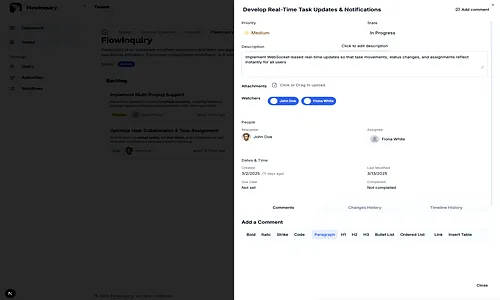
Boost Team Productivity: FlowInquiry Adds Project Management with Kanban & Collaboration
FlowInquiry expands beyond workflow automation with its new Project Management module! Now, teams can efficiently manage both stakeholder requests and internal projects using Kanban boards, drag & drop task management, and multi-project tracking. Enhance collaboration, streamline operations, and keep everything organized—all within FlowInquiry.