Top Open-Source Project Management Tools in 2025 (Including FlowInquiry Community Edition)
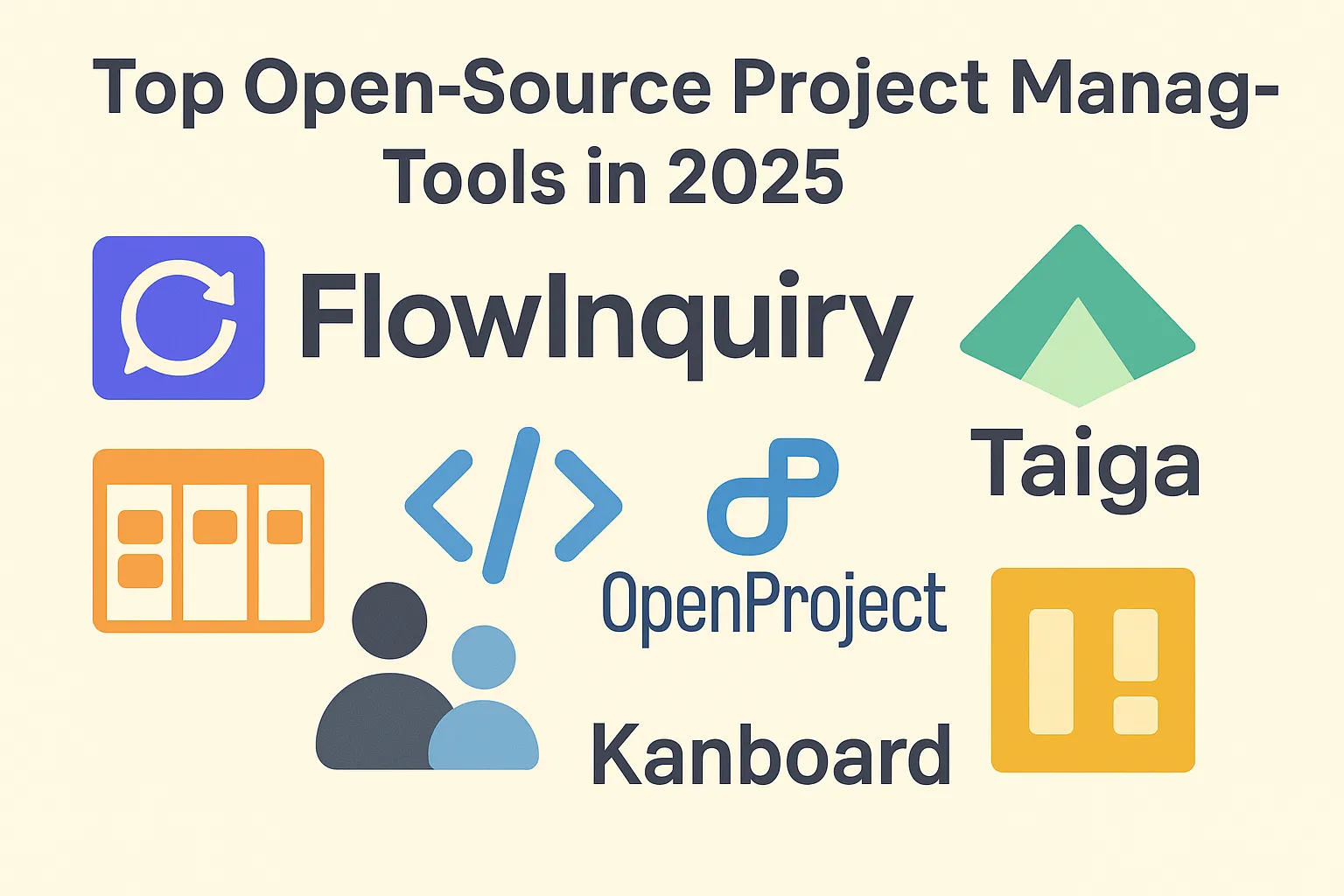
Top Open-Source Project Management Tools in 2025
Open-source project management tools are now a practical choice for many teams. In 2025, startups, small businesses, and large organizations are choosing tools they can run themselves, adjust to fit their work, and extend when needed.
This post looks at five open-source project management tools widely used in 2025. It also covers FlowInquiry Community Edition, a newer option focused on team workflows.
1. Taiga
Overview
Taiga is a Python- and Django-based tool for agile project management. It supports Scrum and Kanban workflows. It also includes a task hierarchy—epics, stories, and tasks—and connects with GitHub, GitLab, and Slack.
Why It’s Still Used in 2025
-
Supports Agile Workflows
Sprint boards and velocity tracking are easy to set up and use. -
Flexible Through Plugins
Teams can add features like time tracking and custom reports using plugins. -
Actively Maintained
Taiga stays current with Python and Django. It has an official Docker image for deployment.
2. OpenProject
Overview
OpenProject is a project management tool built with Ruby on Rails. It includes core features like task tracking, Gantt charts, and budgeting. It is used by teams that manage complex projects or need to meet compliance requirements.
Why It’s Still Used in 2025
-
Enterprise-Level Features
Paid modules support portfolios, timelines, and reporting across multiple projects. -
Modern Interface
The UI was rebuilt in Vue.js in 2024. It loads faster and is easier to use. -
Built for Regulated Environments
OpenProject meets standards like SOC2 and ISO-27001 while keeping the platform self-hosted.
3. Redmine
Overview
Redmine is a Ruby on Rails–based project management tool. It supports multiple projects, access control by role, and a wide range of plugins.
Why It’s Still Popular in 2025
-
Stable Core
First released in 2006, Redmine remains dependable. -
Wide Plugin Support
The plugin library includes agile tools, test case management, and time tracking. -
Multi-Language, Multi-Project
Supports multiple languages and isolated project workspaces.
4. Kanboard
Overview
Kanboard is a minimalist Kanban board tool written in PHP. It focuses only on task boards, columns, and basic project features. It works on low-resource systems.
Why It’s Still Popular in 2025
-
Simple Setup
Runs on small servers and loads quickly. -
Community Features
Plugins allow task predictions, color-coded swimlanes, and auto-archiving. -
Embedding Support
Teams display task boards inside dashboards using read-only widgets.
5. FlowInquiry Community Edition (Newcomer)
FlowInquiry is a newer option built with a Next.js frontend and a Spring Boot backend. It combines project management with request tracking, notifications, and analytics.
What Stands Out
-
Team-Oriented Design
The platform focuses on team workflows. Teams can monitor throughput, manage SLAs, and adjust work based on capacity. -
Clear Interface
The UI groups users, teams, and projects in one view. The Kanban board includes filters and drag-and-drop task updates. -
Real-Time Alerts
FlowInquiry notifies users when tasks change, SLAs are near breach, or comments are added—via Slack or email. -
Built-In Metrics
Teams can see velocity, resolution time, and task distribution. This helps find slowdowns and improve output. -
Efficient and Scalable
FlowInquiry works on a small server. It also supports Kubernetes and Redis for larger use cases.
Installation
- FlowInquiry installs with a single command using Docker Compose.
- A Helm chart is available for Kubernetes.
- Upcoming support for AWS and Azure Marketplace installers.
- Hardware needs: 2 vCPU / 4 GB RAM is enough for most teams.
Who It’s For
-
Teams That Prioritize SLAs
Built-in tracking and notifications help ensure deadlines are met. -
Groups With Simple Infrastructure
You can deploy without needing advanced DevOps skills. -
Teams That Prefer to Self-Host
FlowInquiry uses AGPL v3. You control your data and any changes you make. -
Organizations Seeking Low Upkeep
The system tracks updates and alerts admins when an upgrade is needed.
Conclusion
By 2025, five open-source project management tools stand out:
- Taiga – agile-focused, plugin-friendly
- OpenProject – enterprise features and compliance
- Redmine – mature and highly extensible
- Kanboard – minimal and lightweight
- FlowInquiry – team-focused, simple to run, with built-in tracking
Each tool serves a different need. Taiga and Redmine work well for engineering teams. OpenProject fits structured, portfolio-driven work. Kanboard is ideal for simple setups. FlowInquiry bridges team collaboration and request tracking in a single platform.
If you want a project tool you can self-host and grow into, FlowInquiry is worth trying.
Table of Contents
Related Articles
Why We Open Sourced Spring TestContainers Beyond FlowInquiry
At FlowInquiry, we don’t just build features—we build reusable tools. Spring TestContainers started as an internal solution for integration testing and is now available as an open source library. It supports PostgreSQL, MySQL, Ollama, and can be extended to Redis, Kafka, and more.
FlowInquiry v1.2.2: Laying a Strong Foundation for What’s Next
FlowInquiry v1.2.2 delivers a clean database refactor for easier data migrations, expanded automated testing, and refreshed documentation—laying the foundation for upcoming project-management features and smoother future development.
Self-Host FlowInquiry with a Single Command – Fast, Easy Setup
FlowInquiry makes self-hosting simple. With just one command, you can launch the full platform — including backend, frontend, and database — on your local machine or server. No complex configuration required